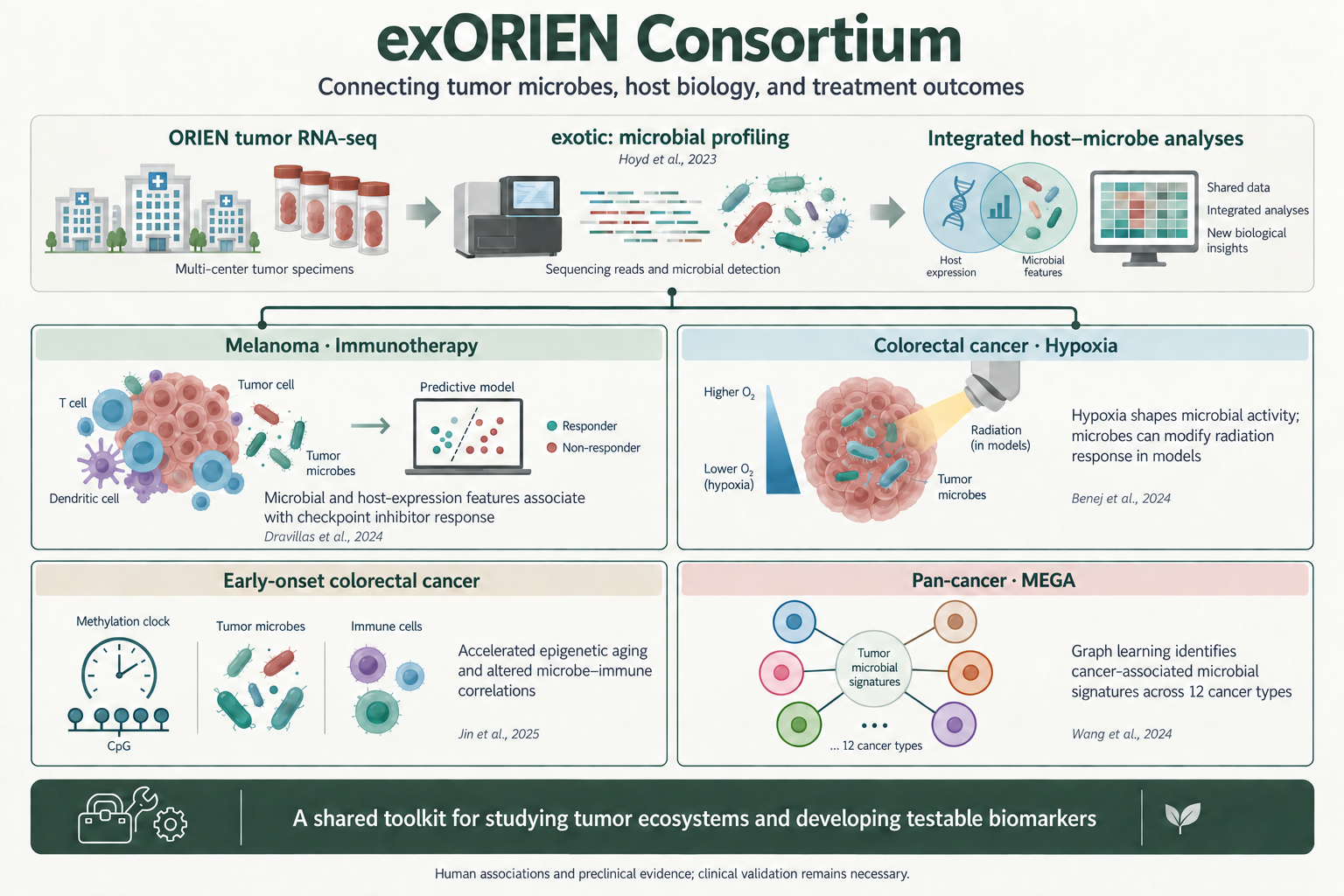
The exORIEN Consortium studies exogenous sequences within tumor RNA sequencing data: microbial signals that can help explain relationships between cancer, the tumor microenvironment, and treatment outcomes. The collection brings together manuscripts prepared in parallel through an Oncology Research Information Exchange Network (ORIEN) intermember project. The consortium subsequently expanded into ORIEN’s formal Microbiome Research Interest Group (RIG).
Explore the Microbiome RIG and its subsequent papers and abstracts.
The studies below share a computational foundation: exotic, a tool for estimating microbial abundances in tumor RNA sequencing data. Each manuscript addresses a distinct biological question, with its own analysis repository.
Collection at a glance
Published studies
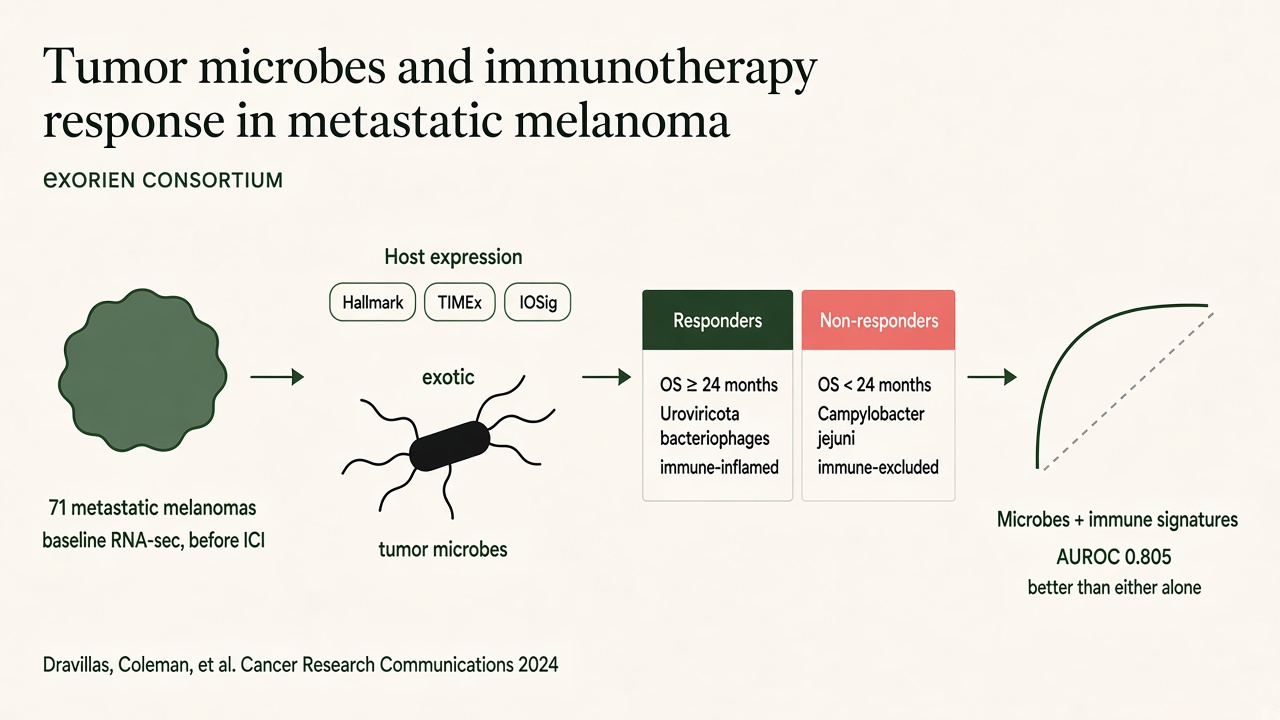
Melanoma: tumor microbes and immunotherapy outcomes
exorien-melio
Analyses of the metastatic melanoma tumor microbiome and its relationship to outcomes in patients treated with immune checkpoint inhibitors.
Dravillas CE et al. (2024). The Tumor Microbiome as a Predictor of Outcomes in Patients with Metastatic Melanoma Treated with Immune Checkpoint Inhibitors. Cancer Research Communications, 4(8), 1978–1990.

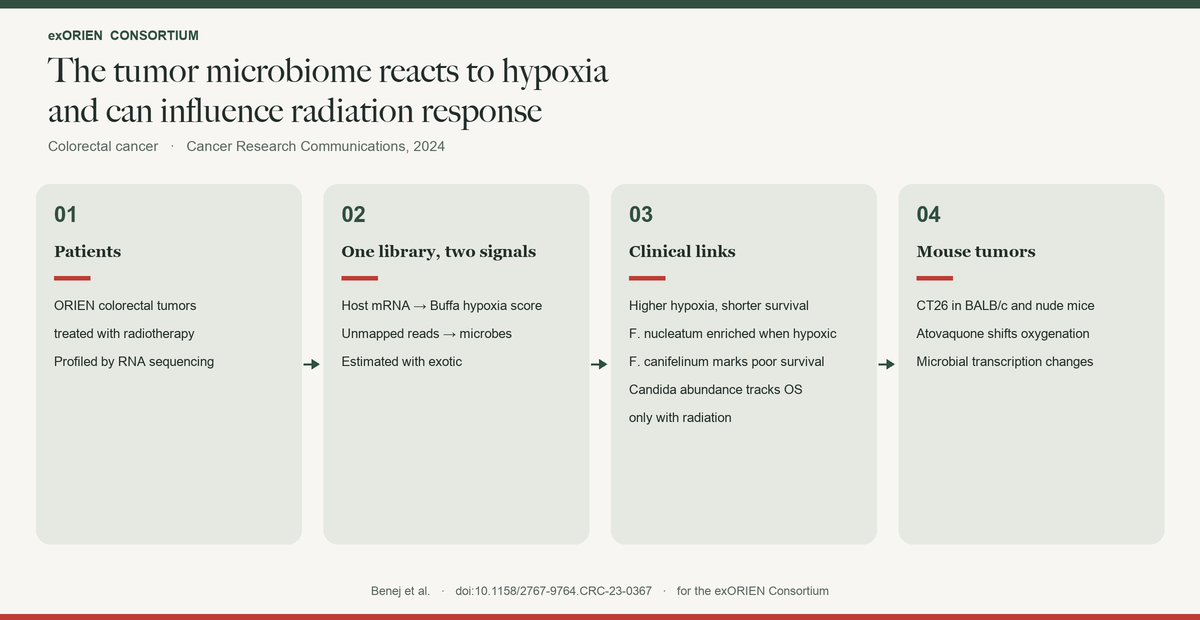
Colorectal cancer: hypoxia and radiation response
exorien-recrad
A study of interactions between tumor oxygenation, microbial communities, and response to radiation treatment in colorectal cancer.
Benej M et al. (2024). The Tumor Microbiome Reacts to Hypoxia and Can Influence Response to Radiation Treatment in Colorectal Cancer. Cancer Research Communications, 4(7), 1690–1701.

Early-onset colorectal cancer: epigenetics, microbes, and immunity
exorien-exogieo
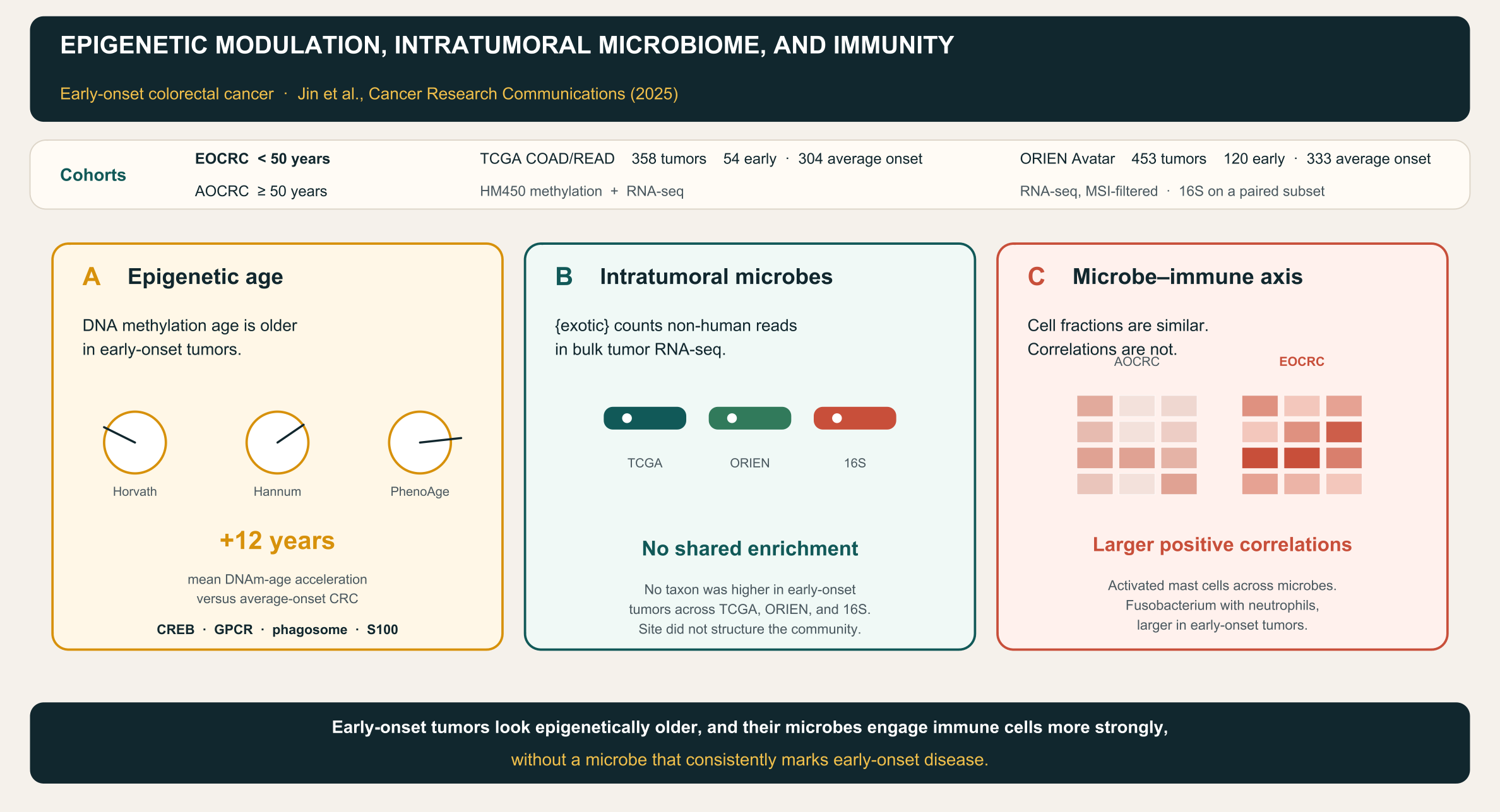
Analyses of DNA methylation, intratumoral microbes, and immune-cell composition in early-onset and average-onset colorectal cancer.
Jin N et al. (2025). Epigenetic Modulation, Intratumoral Microbiome, and Immunity in Early-Onset Colorectal Cancer. Cancer Research Communications, 5(11), 1985–1997.

Pan-cancer microbial signatures: MEGA
MEGA
MEGA uses a graph-based deep learning approach to identify cancer-associated intratumoral microbes across 12 cancer types in the ORIEN dataset. Microbial abundances were calculated with exotic before MEGA modeled relationships among microbes and cancer types.
Wang C et al.; exORIEN Consortium (2024). A Bioinformatics Tool for Identifying Intratumoral Microbes from the ORIEN Dataset. Cancer Research Communications, 4(2), 293–302.
Read the paper · Open-access full text · Software and tutorials: OSU-BMBL/MEGA
Shared methods: exotic
exotic
Exogenous Sequences in Tumors and Immune Cells (exotic) identifies low-abundance microbial sequences in host-dominated sequencing data, with processing and contamination-filtering functions. It provides the shared microbial profiling approach used by the manuscripts above.
Hoyd R et al. (2023). Exogenous Sequences in Tumors and Immune Cells (Exotic): A Tool for Estimating the Microbe Abundances in Tumor RNA-seq Data. Cancer Research Communications.
Methods paper · Software and installation · User manual · Methods-paper analyses
Tumor microenvironment signatures: tmesig
tmesig
The consortium’s earlier methods guidance identifies tmesig as the shared package for calculating expression signatures. Alongside microbial profiling with exotic, these scores help researchers characterize host features such as hypoxia, immune activity, and tumor-cell phenotype.
Conference abstracts and presentations
These early reports document the development and dissemination of the original consortium studies. Full journal articles are collected above; additional records and talk details are in Daniel Spakowicz’s CV.
Conference abstracts
- Jin N, Hoyd R, Yilmaz A, et al.; Spakowicz D; exORIEN Consortium (2024). “Microbiome signature, immune landscape and global methylation in early onset colorectal cancer.” ASCO Annual Meeting, June 1, 2024. Journal of Clinical Oncology, 42(16 Supplement), 3580. Abstract. This work developed into the early-onset colorectal cancer paper above.
- Hoyd R, Wheeler C, Coleman S, et al.; Spakowicz D (2023). “The tumor microbiome associates with features of the tumor microenvironment, treatment outcomes, and histologies: a national collaboration of the exORIEN Consortium.” AACR Annual Meeting. Cancer Research, 83(7 Supplement), 5907. Abstract.
- Wheeler CE, Coleman S, Hoyd R, Osman A, Denko L, Tan AC, Spakowicz D, Tarhini A (2023). “Intra-tumor microbes identified by RNAseq associated with response to immune checkpoint blockade in metastatic melanoma.” AACR Annual Meeting. Cancer Research, 83(7 Supplement), 5904. CV record. This work preceded the melanoma paper above.
- Jin N, Mo X, Hoyd R, Yilmaz AS, Liu Y, Jagjit Singh M, Muniak M, Hampel H, Spakowicz D (2021). “Microbiome signature, global methylation and immune landscape in early onset colorectal cancer.” ASCO Annual Meeting. CV record.
Consortium and methods talks
The following invited talks were presented by Daniel Spakowicz and are recorded in his CV.
- October 17, 2023 — “Exploring the tumor microbiome with ORIEN sequencing data.” The Ohio State University Comprehensive Cancer Center Annual Scientific Meeting; Columbus, OH.
- May 15, 2023 — “The exORIEN Consortium: Progress and Future Directions.” The Ohio State University Comprehensive Cancer Center; Columbus, OH.
- March 2, 2023 — “The tumor microbiome associates with features of the tumor microenvironment, treatment outcomes, and histologies; a national collaboration of the exORIEN Consortium.” ORIEN Scientific Retreat; Salt Lake City, UT.
- March 1, 2023 — “The {exotic} tool for detecting low abundance microbes in high-throughput sequencing data: processing, decontamination, and validation.” ORIEN Scientific Retreat, Artificial Intelligence/Machine Learning Session; Salt Lake City, UT.
- February 28, 2023 — “The tumor microbiome associates with features of the tumor microenvironment, treatment outcomes, and histologies; a national collaboration of the exORIEN Consortium.” Oncology Data Science Symposium, Huntsman Cancer Institute; Salt Lake City, UT.
- December 9, 2022 — “Comparison of the Oral and Tumor Microbiomes Between Appalachian and non-Appalachian patients.” ORIEN Scientific Committee; online.
- April 14, 2022 — “Exogenous sequences in unmapped tumor transcriptome data.” Ohio SuperComputing StateWide User’s Group Annual Meeting; Columbus, OH.
Later conference reports and presentations are collected on the Microbiome RIG page.
Consortium background
The project developed through coordinated subgroup analyses and shared discussion among ORIEN members, and expanded into the formal Microbiome RIG. Early results were presented at ORIEN scientific retreats, ASCO, AACR, and microbiome meetings in 2022–2023, spanning pan-cancer microbial profiling, melanoma immunotherapy, and colorectal cancer hypoxia and radiation response.
The original consortium website served as a collaboration hub for meeting resources, manuscript planning, dataset documentation, and technical questions. Its dissemination archive preserves early abstracts, posters, and presentations. The published studies and their analysis repositories are collected above.
Explore and collaborate
About ORIEN · Lab publications · All lab software
For questions about the lab’s exORIEN work or opportunities to collaborate, contact Daniel Spakowicz.